

Duct access doors, or HVAC access doors, provide safe and easy access to the interior of ductwork, allowing ducts, as well as critical infrastructure installed inside of ducts, to be inspected and serviced. A well-placed duct access door can help simplify future HVAC maintenance. For example:
- A duct access door placed near a duct sensor allows technicians to investigate the location where the sensor reading was taken.
- A duct access door installed next to motorized actuators provides a safe opening for inspection and periodic maintenance.
- A duct access door located near critical components makes it easy to remove broken components and install replacements.
- A duct access door with a viewport can allow for visual inspection of ductwork internals without having to open the duct door itself, avoiding airflow and pressure losses during HVAC system operating hours.
Common locations to install a duct access door
Duct access doors are commonly installed in locations that house critical infrastructure. Examples of infrastructure, and why to place doors nearby, include:
Duct Sensors: Critical to HVAC system operations, duct sensors are temperature, humidity, and/or pressure sensors that monitor conditions inside of ductwork. Size and locate doors by sensors to verify sensors are working, take electrical readings, and test the air.
Life Safety Dampers: Life safety dampers comprise fire dampers, smoke dampers, and combination fire/smoke dampers, and prevent smoke and fire from spreading inside of ductwork. Place access doors as close as possible to life safety dampers to ensure access to blade linkage and internally mounted actuators.
Heating and Cooling Coils: Heating and cooling coils control the temperature of conditioned air. Size and locate access doors to facilitate thorough inspection and cleaning.
Fans: Fans distribute air through ductwork. Size and locate doors to enable inspection, maintenance, cleaning, lubrication, and possible replacement of bearings, belts, and motors.
Security Grates: Security grates are bars that prevent people and contraband from passing through the ducts. Size and locate access doors to allow for routine inspecting and cleaning.
Air Filters and Filter Racks: Air filters further clean conditioned air. Size and locate access doors at filter racks to allow for easy cleaning and/or replacement of filter media.
These infrastructure elements require periodic inspection, maintenance, and, if they break, replacement. Installing an access door nearby gives technicians direct and clear access to the infrastructure that needs attention, improving the safety and efficiency of HVAC service visits.
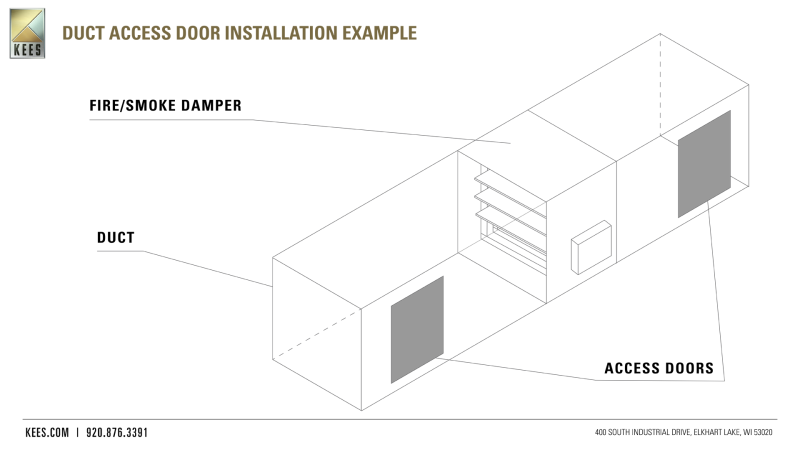
How to choose the right placement for a duct access door
Choosing the right location is only part of installing a duct access door. It's equally important to consider where on the duct the access door will be placed. The ideal location should:
- Be physically accessible, i.e., in a location with space for the access door to be opened/removed, and for a person to stand in front of/below it.
- Provide clear visibility into the ductwork to aid in periodic visual inspections.
- Give safe access to infrastructure, without sharp objects, blades, or other mechanisms in the way.
- Provide ample space inside and outside the ducts for technicians to remove broken parts and install replacements.
Considerations for specifying the right access door
Consider the following when specifying the right access door for a given installation:
Size: the size of the access door determines what will fit inside of it. To choose the right size, answer the following questions:
- Does the access door need to be big enough for a person to enter? If so, the minimum required size is 20"x20".
- Is the opening of the door large enough for components to be removed and/or replaced?
- Can all the tools needed to service the components fit safely inside?
Inside or Outside: Access doors intended for exterior ductwork are constructed differently than access doors for interior ductwork. Pay close attention when specifying to ensure the correct door is ordered.
Underside Access: Underside access refers to a duct access door that is placed underneath the duct. Ceiling ducts are most commonly installed with underside access, allowing technicians to more easily inspect overhead ducts.
Opening Method: Access doors can be hinged, bolted, or cammed. For access doors that offer underside access, accessories like limit stops or safety chains prevent hinged access doors from swinging open or came doors from falling out of the frame due to gravity.
Why KEES
When space is tight and installation locations are very precise, only an odd-sized access door will do. At KEES, we're willing and able to make duct access doors to your exact specifications. Our uniquely flexible production environment manufactures large quantities of standard doors, alongside specially sized doors just for our clients. We can further customize access doors with material options and helpful accessories to help you meet your specific access requirements.